
Heather R. Hayes, M.Ed., LPC, CIP
When a family reaches out for help with a mental health or substance use crisis, they are usually reaching out after the situation has reached a critical stage. Someone has overdosed, or has stopped eating, or has not slept in four days and is talking about things no one else can see. The family is frightened and worn down, and they are being asked to make serious decisions quickly with very little information. In that moment, anyone who speaks the language of recovery with confidence can look like exactly the help they need, especially if there are a few letters after their name.
Confidence and personal experience matter a great deal in this work. They are also different from education and supervised practice, and neither one grants the legal authority to provide clinical care. Before hiring an interventionist, recovery coach, sober companion, or any other behavioral health professional, a family deserves to know what that person has been trained to do and where that training stops. They also deserve to know who will hold that person accountable if something goes wrong.
I want to be clear from the start that I am writing in support of peer work. People who have lived through addiction and recovery bring something that a clinician without that history often cannot, which is living proof that change is possible. Many families find that the first person to truly get through to their loved one is someone who has been there. The question I am raising is narrower and more practical: does the service being offered match the training and the role of the person offering it?
A Personal Recovery Story Is Valuable, and It Is a Different Thing From Clinical Training
A person’s own recovery can help them reach someone who feels isolated or who has stopped believing that change is possible. A good recovery coach helps a person set goals, build daily structure, find community resources, and stay connected to treatment, drawing on lived experience along the way. That is meaningful work, and it deserves respect.
Lived experience alone, though, does not prepare someone to assess a family system or recognize a psychiatric condition. It does not teach a person how to evaluate suicide or violence risk, or how to tell when agitation and confusion might have a medical cause such as withdrawal, a head injury, or an infection. Those tasks call for specialized education, supervised experience, and a working knowledge of one’s own limits. In a complex case, a peer worker belongs on a coordinated team, and part of their skill is knowing when to bring in a licensed clinician or a physician.
The national standards reflect this. SAMHSA describes peer workers as people who use their lived experience to support others, and it publishes core competencies for that role.[1] NAADAC’s national peer recovery credential frames recovery support as a supervised role, and its code of ethics states that a National Certified Peer Recovery Support Specialist does not practice independently, works under supervision, and stays within the scope of their expertise.[2] Diagnosis and clinical treatment require separate qualifications, and they are governed by the law of the state where the services are delivered.
We understand this distinction easily in other professions. No one would hand a person a nurse’s duties because they once received excellent nursing care, and being well represented by a lawyer does not qualify anyone to practice law. Experience can make someone a powerful advocate and guide. The authority to assess and treat another human being has to come from somewhere else.
A Workforce That Grew Faster Than Its Guardrails
Peer support has moved from the margins of the behavioral health system toward its center in about twenty-five years, and Georgia was there at the beginning. The first Medicaid-reimbursable certified peer specialist credential in the country was implemented in Georgia in 2001.[3] Other states followed steadily. When SAMHSA released its National Model Standards for Peer Support Certification in 2023, it reported that 49 of the 50 states had state-run or state-endorsed peer certification programs.[4] A 2024 review by the Policy Center for Maternal Mental Health found that 48 states and the District of Columbia reimburse peer support services through Medicaid in some form.[5]
That growth is good news for families, because it puts trained people in emergency departments, jails, clinics, and neighborhoods where help used to be scarce. It also means the credential behind a person’s title can mean very different things depending on where they trained. A 2026 study in Psychiatric Services examined peer specialist credentialing in the 40 states whose Medicaid programs covered peer support for substance use disorder in 2024. Although most states shared common elements such as training and an examination, the authors found considerable variation from one state to the next, with recertification fees alone ranging from $15 to $200, and they called for more transparency and greater harmonization across states.[6] SAMHSA wrote its model standards for the same reason, as guidance to encourage alignment and reciprocity among what it called “often disparate” state certifications.[4]
Intervention sits even further from the regulatory light. No state that I am aware of licenses interventionists as a distinct profession, and in most of the country a person can begin calling themselves an interventionist tomorrow. Voluntary credentials exist, and I discuss them below, but a family has no way of knowing whether a given interventionist holds one unless they ask.
What Licensure and Certification Tell You
The words can be confusing because states use them differently. In general, a license is a government authorization to practice a regulated profession in a particular jurisdiction. State licensing boards set the requirements, define the legal scope of practice, verify qualifications, and can investigate complaints and impose discipline. In Georgia, for example, professional counselors, clinical social workers, and marriage and family therapists are overseen by a state licensing board, and the professional counseling rules require graduate education and supervised experience before licensure.[7][8] Every state has a comparable structure for its licensed mental health professions, although the titles and requirements differ.
A certification is granted by a professional organization, a state agency, or another certifying body, and its value depends on who issued it and what the person had to do to earn and keep it. Some certifications require substantial education, supervised hours, an examination, continuing education, and adherence to a code of ethics. Others amount to little more than proof that someone sat through a short course. A certificate of course completion is not automatically a professional certification, and neither one automatically grants a license or permission to provide clinical services.
State exceptions make this more complicated. Georgia, for instance, does not license alcohol and drug counselors as a separate profession. The Alcohol and Drug Abuse Certification Board of Georgia issues credentials that state law recognizes for particular scopes of addiction counseling, and the Board distinguishes those credentials from its peer recovery coach credentials.[9] Other states license addiction counselors directly, and some do both. This is exactly why families need to check the rules in the state where the service is being provided instead of relying on a general label.
A license does not guarantee that a practitioner will always act ethically, and a complaint does not always lead to discipline. What a license does give the public is a defined place to verify a practitioner’s standing and to report alleged violations within the board’s authority. Georgia’s Secretary of State, like licensing authorities in other states, offers online license verification and a process for filing a complaint.[10] The Association of Social Work Boards maintains similar guidance for social workers nationally.[11] Some certification boards also publish ethics codes and complaint procedures, and families should find out whether the particular credential in front of them carries those safeguards and whether the person is in good standing.
What Happens When The Market Outruns Oversight
Families do not have to imagine what happens when a loosely regulated field meets a desperate population with good insurance. It has already happened, more than once.
In South Florida during the last decade, a practice that came to be called the “Florida shuffle” moved young people from treatment center to sober home and back again while their insurance was billed. NBC News told the story of one young woman whose insurance was billed more than $1 million during fifteen months in which she passed through nine treatment centers.[12] Palm Beach County State Attorney Dave Aronberg formed a Sober Homes Task Force in 2016 to respond. By the end of 2017, it had made 41 arrests, mostly for patient brokering, which is a third-degree felony in Florida, and it had worked with federal prosecutors on the case of a treatment center and sober home operator who was sentenced to 27 and a half years in prison.[13] By 2021, the task force had announced its 117th arrest.[14]
Arizona offers a more recent, and in some ways more painful, example. In May 2023, the state’s Medicaid agency, AHCCCS, announced allegations of widespread fraud involving sober living homes and behavioral health providers. The scheme primarily victimized Native American and Indigenous people who were seeking help with substance use. By the end of 2024, 266 providers were under payment suspension with open law enforcement cases. The state’s humanitarian response had served more than 11,500 people, and 4,147 of them had to be given temporary hotel lodging.[15]
Congress responded to patterns like these with the Eliminating Kickbacks in Recovery Act, enacted in October 2018 as part of the SUPPORT for Patients and Communities Act. The law makes it a federal crime to pay or receive anything of value for referrals to recovery homes, clinical treatment facilities, and laboratories. It applies to private insurance as well as government programs, and it carries penalties of up to $200,000 and ten years in prison for each occurrence.[16] The Department of Justice has used this and related laws to prosecute addiction treatment referral schemes in which patient recruiters were paid illegal kickbacks.[17]
In many of these cases, the people doing harm presented themselves as helpers and spoke the vocabulary of recovery fluently. A credential check would not have stopped every one of them, but it would have given families somewhere to start asking questions.
Intervention Credentials Matter, and So Do Their Limits
Intervention work is often treated as though anyone with personal experience of recovery can do it. That overlooks how much preparation it takes to guide a family through a high-stakes process. An intervention can involve risk assessment, family dynamics, crisis response, and the choice among treatment options, along with the judgment to recognize when a situation needs immediate clinical or medical attention.
The Certified Intervention Professional credential, or CIP, is a meaningful intervention-specific credential to look for. The Pennsylvania Certification Board’s requirements include relevant education and training, supervised work experience, 100 hours of on-the-job supervision, and documented participation in and facilitation of interventions. Its curriculum covers intervention practice, family systems, motivational interviewing, addiction, crisis intervention, and behavioral health ethics.[18]
I hold the CIP and value it, and I also want families to understand what it is. A CIP is a certification, not a mental health license. It does not, by itself, authorize someone to diagnose or treat a psychiatric condition. When the situation involves significant mental health symptoms, trauma, an eating disorder, cognitive changes, suicidal risk, or other complex needs, families should ask whether the interventionist also holds a clinical license. If the interventionist is not a clinician, ask who provides clinical consultation and supervision and how the team responds when a clinical issue emerges in the middle of the work.
Peer Support Deserves Good Training and Clear Boundaries
The right response to all of this is to expect more from recovery coaches and peer specialists, never to dismiss them. That means appropriate preparation, regular supervision, ethical standards, and an honest description of the role.
A National Pathway
For a credential that is recognized across state lines, NAADAC offers the National Certified Peer Recovery Support Specialist. It requires a high school diploma or equivalent, at least two years of recovery, 200 hours of direct peer practice, and 60 hours of peer recovery education and training. That training includes ethics along with documentation, crisis management, service coordination, cultural humility, referral, and basic pharmacology, and renewal requires continuing education.[2] Families should still ask whether a state or local credential is required for the specific work being offered, since pathways and rules vary.
Connecticut: A Model Worth Knowing
Connecticut is where much of modern recovery coach training began, and it is a useful model for families anywhere. The Connecticut Community for Addiction Recovery, known as CCAR, developed the Recovery Coach Academy, a 30-hour training now taught across the country and abroad. CCAR reports that it has trained more than 110,000 people worldwide, and many states accept the Academy toward their own peer credentials.[19] Its coaches work in some demanding settings. Since 2017, CCAR recovery coaches have met with patients who arrive in hospital emergency departments after an overdose or another alcohol or drug crisis, and the program now operates in 32 Connecticut emergency departments.[20]
Completing the Academy produces a certificate of attendance, and Connecticut trainers are careful to say that this certificate is not a certification.[21] For coaches who want to go further, CCAR offers the Recovery Coach Professional designation, or RCP. The RCP requires 60 hours of training, including the Academy and a 16-hour course called Ethical Considerations for Recovery Coaches, along with a review of the applicant’s professional and personal history. Candidates then sit for a live interview before a panel of peers who assess whether they can actually coach. There is no written test because CCAR designed the process to evaluate skill in practice, having concluded that most coaching credentials relied only on accumulated training hours and a standardized exam.[19]
Connecticut has also moved to formalize peer work at the state level. The Department of Mental Health and Addiction Services created the Certified Peer Support and Recovery Professional credential, or CPSRP, which brings Recovery Support Specialists and Recovery Coaches under a single state credential administered by the Connecticut Certification Board. New applicants complete an 80-hour curriculum from a DMHAS-approved training organization, aligned with SAMHSA’s core competencies and the state’s peer ethics and values standards. People trained on or before May 31, 2026, through an approved organization, including CCAR, can grandparent into the new credential through October 1, 2026.[22] Separately, the Connecticut Certification Board offers the Certified Peer Recovery Specialist credential through IC&RC, which requires 500 hours of paid or volunteer work experience, 25 hours of supervision, a signed code of ethics, and a passing score on the IC&RC peer recovery examination. Because IC&RC credentials transfer among its member boards, a coach who holds the CPRS can carry it into other participating states.[23]
What Connecticut illustrates is a layered system in which each layer means something specific. A family there can ask whether a coach is CCAR-trained, whether they have earned the RCP, and whether they hold the state CPSRP or the IC&RC CPRS, and each answer tells them something concrete about the person’s preparation and accountability.
Georgia Pathways
In Georgia, people interested in peer recovery work can explore the Certified Addiction Recovery Empowerment Specialist Academy, known as CARES, through the Georgia Council for Recovery, which includes 40 hours of training and an examination.[24] The Alcohol and Drug Abuse Certification Board of Georgia offers a Certified Peer Recovery Coach credential, which it describes as a way to verify peer recovery education, ethics, and experience.[9] Georgia also has state-recognized peer specialist pathways through the Department of Behavioral Health and Developmental Disabilities.[25] All of these are peer credentials designed for peer support roles, and none of them substitutes for a clinical license. Applicants should confirm current requirements with each issuer.
A training certificate can be a useful first step in any state. It should never be presented as proof that someone is qualified to conduct a mental health assessment or to direct treatment independently. Good peer practice includes working within a written role, receiving regular supervision, protecting confidentiality, and knowing when to refer and collaborate with clinicians.
Look Closely at Conflicts Of Interest and Referral Payments
Credentials matter, partly because ethics codes set standards for conflicts, boundaries, and financial relationships and partly because they tell a family whether the person answers to a board or organization at all.
A family should ask whether an interventionist or coach receives money, gifts, or any other benefit for referring someone to a particular treatment center, laboratory, or recovery residence. Referral compensation can put a professional’s financial interests in direct conflict with a family’s needs. In some circumstances it is also illegal. Georgia’s Attorney General describes state restrictions on compensation and split-fee arrangements for referrals to or from substance use providers,[26] and the federal Eliminating Kickbacks in Recovery Act applies nationwide.[16] Many states have their own patient brokering statutes as well. The legal analysis depends on the facts and on the exceptions that apply, so families should not assume that every business relationship is unlawful. They should insist on transparency.
The same care is needed when one person occupies more than one role. An interventionist who also works for a treatment center may have a legitimate, fully disclosed relationship, and a family should understand that relationship before accepting a recommendation. Ask whether the person is employed by, contracted with, or paid by the program. Ask whether the recommendation is based on your loved one’s clinical needs and fit and whether other options will be discussed with you.
Boundaries between coaching, treatment, and mutual aid also matter. A sponsor and a paid recovery coach have different roles. NAADAC’s peer code says a peer recovery specialist should not sponsor a person they currently serve or have previously served, and Georgia’s addiction counselor ethics standards likewise prohibit an alcohol and drug counselor from becoming a sponsor or peer coach to a current or discharged service recipient or to that person’s family.[2][27] The reasoning behind both standards is simple. When roles are combined, consent, privacy, loyalty, and responsibility all become harder to sort out.
Credentials Are More Than Letters After a Name
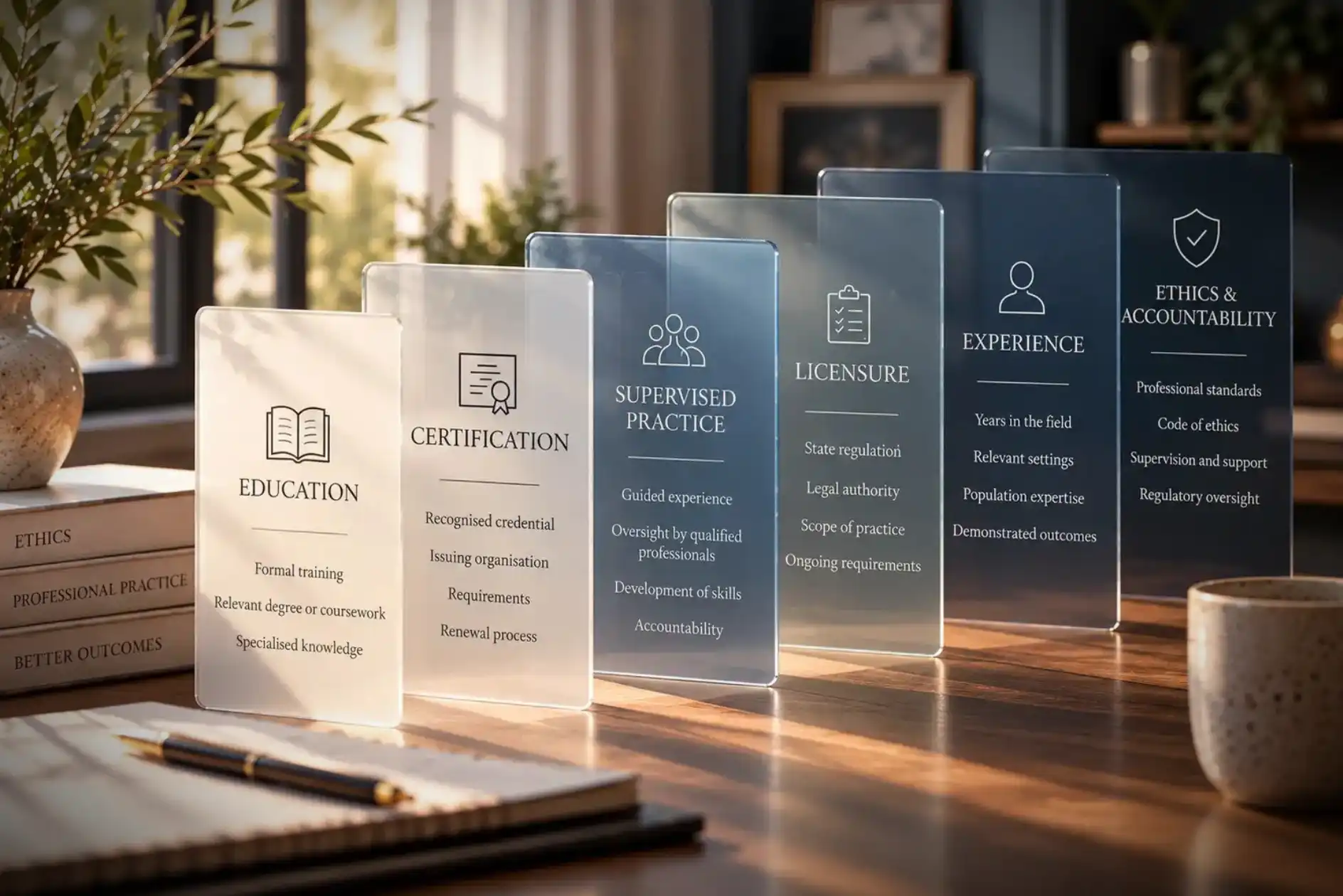
Families should verify each credential instead of counting the letters. Find out who issued it and whether that organization is recognized by a state, a professional board, or an established credentialing body. Ask what education, supervised practice, and examination were required, whether the credential must be renewed, and whether it comes with a published code of ethics, a public directory, and a complaint process. Ask whether the person carries professional liability insurance appropriate to the work.
Ask the professional to explain each credential in plain language, and then verify it directly with the issuing board or organization. For a license, use the state board’s public lookup. For a certification, contact the certifying body and ask whether the credential is active, what its scope is, and how concerns are handled. A credential with an impressive title may still have nothing to do with a government license.
Privacy deserves its own question. Federal rules at 42 CFR Part 2 place special confidentiality protections on substance use disorder treatment records held by covered programs.[28] Many private coaches and interventionists fall outside those rules, which makes it even more important to ask how the person will handle the information your family shares.
Families should also ask what the professional will do if their loved one appears psychotic, medically unstable, suicidal, or at risk of harming someone. A responsible professional will not promise to manage every situation alone. They will explain how they work with clinicians, emergency services, and treatment providers and when they will refer or step back.
Questions To Ask Before Hiring Someone
- What is your exact role, and what services fall outside your scope?
- What license or certification do you hold, who issued it, and where can I verify it?
- What education, supervised hours, and examinations did that credential require?
- Who supervises your work, and how often do you meet?
- What experience do you have with this particular combination of needs?
- Are you employed by, paid by, or receiving referral compensation from any treatment center, laboratory, or recovery residence you might recommend?
- What happens if the situation becomes a psychiatric or medical emergency?
- How will you protect the confidentiality of what our family shares with you?
- What is your complaint process, and what professional liability coverage do you carry?
Asking these questions is a normal part of informed decision making, and a qualified professional will welcome them. A family is entrusting someone with a vulnerable person and a complicated situation, and they have every right to understand who that someone is.
We Need Stronger Public Protections
Behavioral health and recovery support need room for peer work and lived experience. They also need clearer public standards for the people who assess, intervene, coordinate care, and make recommendations to families in crisis. SAMHSA’s national model standards are a step toward consistency for peer workers, but they are limited to a guidance role, and each state still decides for itself.[4] Intervention has no comparable national framework at all.
At a minimum, a consumer anywhere in the United States should be able to tell whether a provider is a peer, a coach, an intervention professional, an addiction counselor, or a licensed clinician. Each of those roles should come with an honest scope, appropriate training and supervision, clear ethical expectations, and a way to report serious concerns.
Protecting the people who ask for help and honoring the value of lived experience are compatible goals. Both depend on making sure no one is asked to do work they have not been trained or authorized to do. A family already facing a crisis should never also have to guess whether the person guiding them is qualified for the job.
Sources and Places to Verify Credentials:
- SAMHSA, Core Competencies for Peer Workers in Behavioral Health Services.
- NAADAC, National Certified Peer Recovery Support Specialist requirements, and NAADAC and NCC AP Code of Ethics, including standards on peer supervision, scope, conflicts of interest, and sponsorship.
- “Medicaid Reimbursement of Mental Health Peer-Run Organizations: Results of a National Survey,” PubMed Central. https://pmc.ncbi.nlm.nih.gov/articles/PMC10498960/
- SAMHSA, National Model Standards for Peer Support Certification, Publication No. PEP23-10-01-001 (2023). https://library.samhsa.gov/product/samhsas-national-model-standards-peer-support-certification/pep23-10-01-001
- Policy Center for Maternal Mental Health, “Gaps in Peer Support Reimbursement and Certification in the United States” (2024). https://policycentermmh.org/gaps-in-peer-support-reimbursement-and-certification-in-the-united-states/
- Silwal, S. S., Tormohlen, K., Yu, J., and McGinty, B., “Peer Support Specialist Credentialing in States With Medicaid Coverage of Peer Support Services for Substance Use Disorder,” Psychiatric Services (2026). https://psychiatryonline.org/doi/10.1176/appi.ps.20260055
- Georgia Secretary of State, Board of Professional Counselors, Social Workers, and Marriage and Family Therapists.
- Georgia Rules and Regulations, Requirements for Professional Counselor Licensure.
- Alcohol and Drug Abuse Certification Board of Georgia, Credentials for Addiction and Recovery Professionals.
- Georgia Secretary of State, How to Submit a Licensing Complaint.
- Association of Social Work Boards, Protecting the public and filing a complaint.
- NBC News, reporting on drug treatment operators arrested in Florida and the “Florida shuffle” (2017). https://www.nbcnews.com/health/health-care/florida-drug-treatment-center-operators-busted-crackdown-n784326
- Testimony of Palm Beach County State Attorney Dave Aronberg, U.S. House Committee on Energy and Commerce, Subcommittee on Oversight and Investigations, December 12, 2017. https://docs.house.gov/meetings/IF/IF02/20171212/106716/HHRG-115-IF02-Wstate-AronbergD-20171212-SD002.pdf
- NBC News, reporting on the Palm Beach County Sober Homes Task Force’s 117th arrest (2021). https://www.nbcnews.com/health/health-care/lindsay-lohan-s-father-michael-arrested-florida-steering-patients-rehab-n1264460
- Arizona Health Care Cost Containment System (AHCCCS), Sober Living Fraud response. https://www.azahcccs.gov/Fraud/SoberLivingFraud.html
- United States Code, 18 U.S.C. § 220, Illegal remunerations for referrals to recovery homes, clinical treatment facilities, and laboratories (Eliminating Kickbacks in Recovery Act of 2018). https://www.congress.gov/bill/115th-congress/senate-bill/3254/text
- U.S. Department of Justice, Addiction treatment facility operator convicted of paying illegal kickbacks.
- Pennsylvania Certification Board, Certified Intervention Professional credential.
- Connecticut Community for Addiction Recovery, CCAR Training: Recovery Coach Academy and Recovery Coach Professional (RCP) designation. https://ccar.us/ and https://addictionrecoverytraining.org/
- Connecticut Community for Addiction Recovery, Recovery Coaching Programs, Emergency Department Program. https://ccar.us/programs/recovery-coach-programs/
- Rocking Recovery, Training and Certification Information (Connecticut). https://rockingrecovery.org/training-and-certification-information/
- Connecticut Department of Mental Health and Addiction Services, Certified Peer Support and Recovery Professional (CPSRP) Credential. https://portal.ct.gov/dmhas/newsworthy/news-items/certified-peer-support-and-recovery-professional-credential
- Connecticut Certification Board, Certified Peer Recovery Specialist application and FAQs (https://ctcertboard.org/), and Copeland Center, Connecticut peer certification summary (https://copelandcenter.com/peer-specialists/connecticut).
- Georgia Council for Recovery, CARES Academy.
- Georgia Department of Behavioral Health and Developmental Disabilities, Certified Peer Specialists.
- Georgia Attorney General, Recovery Residences and Georgia’s patient brokering law.
- Alcohol and Drug Abuse Certification Board of Georgia, Ethics standards.
- Electronic Code of Federal Regulations, 42 CFR Part 2, Confidentiality of Substance Use Disorder Patient Records.
This article is educational and is not legal advice. Scope of practice, complaint procedures, credential requirements, and referral laws vary by state and by the facts of a particular arrangement. Families should verify current requirements with the relevant licensing board or certifying organization.