
(and how we can gently re-parent ourselves from the Adult ego state)
During parts of the 1960s and 70s, Transactional Analysis (TA) was everywhere: therapy rooms, boardrooms, classrooms, even dinner-party conversations. Eric Berne’s simple but profound ideas about Parent–Adult–Child ego states, games people play, and “I’m OK–You’re OK” language gave people a shared map for understanding themselves and each other.
Today, TA doesn’t get nearly the airtime it deserves, but the theory hasn’t lost its power. If anything, in a world of rapid-fire digital “transactions,” it’s more relevant than ever.
Below, we revisit TA’s history, core philosophy, the role of ego states and games in communication, and why learning to live more from the Adult ego state is a powerful way to navigate life and self-parent with compassion.
Where Transactional Analysis Came From
Eric Berne and the Birth of TA
Transactional Analysis was developed by psychiatrist Eric Berne (1910–1970) in the late 1950s. Trained in psychoanalysis, Berne became disillusioned with how abstract and inaccessible much of it felt to ordinary people. He wanted a theory that was:
- Clinically useful
- Grounded in observable behavior
- Simple enough for clients to use in everyday life
In a series of papers in the 1950s, Berne introduced the idea of ego states and “structural analysis” of the personality, which distinguishes Parent, Adult, and Child as separate ways of thinking, feeling, and behaving. He then extended this into “transactional analysis,” which studies the actual back-and-forth interactions among people.
His major books laid the foundation of the field:
- Transactional Analysis in Psychotherapy (1961) – a technical, clinical exposition of TA as a psychotherapy model
- Games People Play (1964) – a widely popular book that brought TA into mainstream culture and made words like “games” and “transactions” part of everyday language
- Later works such as What Do You Say After You Say Hello? (1972, published posthumously) built upon his ideas on scripts and life plans.
From One Man’s Theory to a Global Movement
By 1964, Berne and his colleagues had founded the International Transactional Analysis Association (ITAA), which became the professional body for training, certification, and publication (including the Transactional Analysis Journal).
TA expanded rapidly through the 1960s–70s as a:
- Psychotherapy model (individual, couple, group, family)
- Educational approach (schools, universities)
- Organizational and leadership tool (workplaces and management training)
Its strength was its language: clear, non-jargon, and deeply usable in daily life.
The Philosophy: Ego States and Scripts
At the heart of TA is a deceptively simple premise:
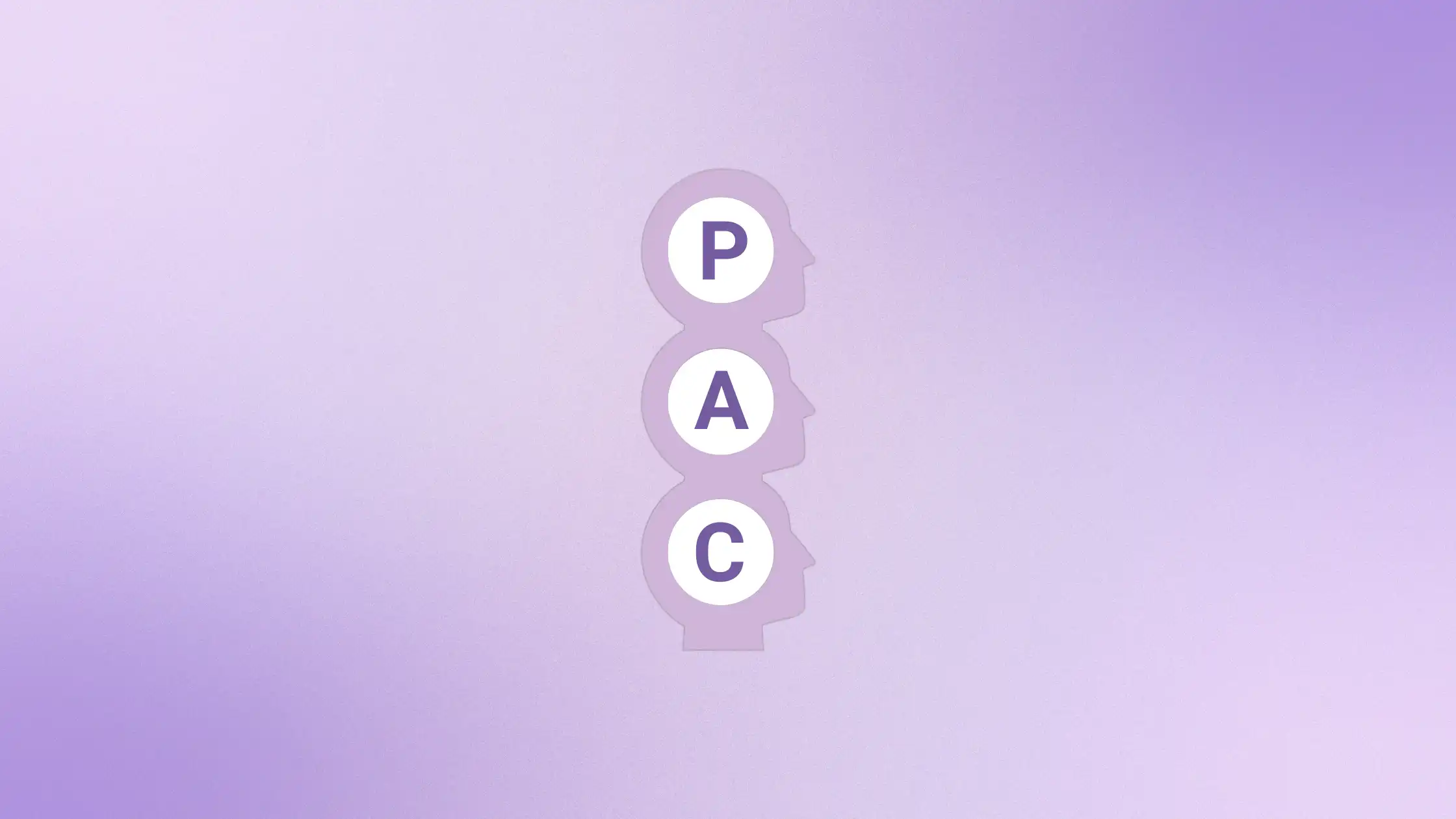
Personality is organized into three observable ego states—Parent, Adult, and Child, and our transactions with others are shaped by which state we are in at any moment.
The three ego states:
- Parent (P)
- Internalized attitudes, rules, and behaviors from caregivers and significant authority figures.
- Can present as:
- Nurturing Parent – caring, comforting, protective
- Critical/Controlling Parent – judging, “shoulding,” shaming, rigid
- Feels like: “You must…,” “You should…,” “That’s not acceptable.”
- Adult (A)
- Our here-and-now, reality-based, data-driven self
- Gathers information, weighs options, and responds appropriately to current circumstances.
- Feels like: “What are the facts?”, “What choices do I have?”, “What’s the best next step?”
- Child (C)
- Our internal storehouse of early feelings, needs, creativity, and vulnerabilities.
- Has different flavors:
- Free Child – spontaneous, playful, curious
- Adapted Child – compliant, anxious, rebellious, or people-pleasing in response to external demands
- Feels like: “I want…,” “I’m scared…,” “This is fun!”
These ego states are not the same as Freud’s id, ego, and superego; they’re observable patterns of behavior, feeling, and thinking that show up in real-time interactions.
Scripts and Life Positions
TA isn’t just about moment-to-moment interactions; it’s also about life scripts, which are unconscious life plans we form early on that are based on repeated childhood experiences and decisions.
Many TA practitioners also use “life positions” (popularized by Thomas Harris as “I’m OK – You’re OK”), which describe basic stances toward self and others, such as:
- I’m OK, You’re OK
- I’m Not OK, You’re OK
- I’m OK, You’re Not OK
- I’m Not OK, You’re Not OK
Healthy development means moving toward “I’m OK, You’re OK”—a cornerstone of Adult-to-Adult relating.
Transactions, Communication Styles, and “Games
Transactions: The Basic Units of Interaction
A transaction is any back-and-forth exchange between two people. TA looks at:
- Which ego state is speaking? (Parent, Adult, or Child)
- Which ego state is being addressed?
For example:
- Adult → Adult: “What time does the meeting start?” / “It starts at 3 p.m.”
- Parent → Child: “You’re late again; this is unacceptable.”
- Child → Parent: “I’m sorry! Please don’t be mad.”
When the expected ego state responds (e.g., Adult to Adult), the communication is usually smooth. When something crosses (e.g., one person speaks from Adult and the other responds from Child), the interaction often breaks down.
This makes TA incredibly useful for:
- Couples and family communication
- Clinical work with highly reactive dynamics
- Workplace leadership, supervision, and conflict resolution
Games: The Hidden Patterns We Repeat
Berne observed that people often engage in repetitive, predictable patterns of interaction that feel familiar but unsatisfying. He called these games, which are sequences of transactions with a hidden payoff and a painful, often predictable outcome.
Examples (from Games People Play):
- “Why Don’t You – Yes, But”
- One person presents a problem, others offer solutions, and every suggestion is met with “Yes, but…”
- Payoff: the “problem-holder” proves that nothing will work, maintaining a script of helplessness or specialness.
- “See What You Made Me Do”
- Someone blames another for their own mistake or reaction: “Because you did X, I had to do Y.”
- Payoff: avoiding responsibility while preserving a victim or persecutor role.
- “Ain’t It Awful”
Two or more people bond over complaining about how terrible things are (the system, their partner, their kids, etc.).- Payoff: pseudo-intimacy and moral superiority without the risk of real vulnerability or change.
From a TA perspective, games are short-term emotional economies: we trade authenticity for a familiar script payoff (being “right,” being the victim, staying small, staying in control).
Balancing Ego States: Living More from Adult and Learning to Self-Parent
One of the enduring gifts of TA is its emphasis on balance among the ego states, especially on strengthening the Adult as a kind of internal conductor.
Why The Adult Ego State Is so Central
The Adult is the only ego state that:
- Lives fully in present time
- Takes in new data instead of replaying old recordings
- Can notice, name, and work with Parent and Child patterns
When we’re working from Adult, we can:
- Notice a harsh inner critic (Critical Parent) and question it
- Recognize old emotional triggers (Child) without letting them run the show
- Make choices based on current reality rather than outdated scripts
In therapy, training, and everyday life, the work is not to kill Parent or Child, but to:
- Soften the Critical Parent and strengthen the Nurturing Parent
- Liberate the Free Child while tending to the fears of the Adapted Child
- Empower the Adult to integrate information from both
Self-parenting Through TA
TA gave language to something we now talk about as re-parenting or self-parenting: using our Adult and Nurturing Parent to respond to the Child’s needs in a way in which our environment may not have.
In practice, that might look like:
- When your Child feels terrified of conflict, your Adult gathers data (“Is this actually dangerous?”), and your Nurturing Parent says, “You’re safe. I’m with you. We can handle this.”
- When your Internal Critical Parent says, “You’re a failure,” the Adult can respond, “That’s an old tape. What are the current facts?” and the Nurturing Parent adds, “You’re learning; mistakes are allowed.”
Over time, this balances the internal system, reduces impulsive games, and allows more Adult-to-Adult relating with others.
Key Figures Who Developed and Expanded TA
While Eric Berne is unquestionably the founder of Transactional Analysis, many others have subsequently developed and diversified the theory and its applications.
Below is a non-exhaustive list of major contributors often credited in the TA literature:
- Eric Berne – Founder; originator of ego states, transactions, games, and scripts; author of Transactional Analysis in Psychotherapy and Games People Play.
- Thomas A. Harris – Popularized TA with I’m OK – You’re OK, focusing on life positions and everyday self-help applications.
- Claude Steiner – Developed concepts around scripts, “stroke economy,” and emotional literacy; author of Scripts People Live.
- Franklin Ernst – Contributed to structural and transactional diagrams (e.g., “OK Corral”) and life positions.
- Muriel James & Dorothy Jongeward – Brought TA into education and personal growth through Born to Win.
- Bob and Mary Goulding – Developed Redecision Therapy, integrating TA with Gestalt techniques to change early decisions and scripts.
- Fanita English – Expanded script theory, motivation, and applications in psychotherapy.
- Jackie Schiff – Known for early work with regressive therapy and psychosis using TA concepts.
- Taibi Kahler – Developed the Mini-script and later the Process Communication Model (PCM), widely used in organizational and coaching contexts.
- Ian Stewart & Vann Joines – Co-authors of TA Today, often cited as one of the clearest modern textbooks and integrative overviews of TA.
- Richard Erskine – Developed relational, integrative TA approaches blending TA with attachment and relational psychotherapy.
- Julie Hay, Anita Mountain, Julie Hay, Susannah Temple – Brought TA deeply into organizational, coaching, and educational work.
- Stephen Karpman – Created the Drama Triangle (Persecutor–Rescuer–Victim) rooted in TA understanding of roles and games.
The TA community today includes many others across psychotherapy, education, coaching, and organizational development, often working through regional TA associations linked to ITAA.
Why TA “Faded”—and Why It’s Still So Valuable
The Rise and Relative Fall
TA’s popularity surged in the 1960s–70s, especially in North America and Europe. Over time, however:
- Academic psychology criticized TA (and other humanistic/pop-psych movements) for its allegedly limited empirical research.
- New therapeutic approaches (CBT, DBT, family systems, attachment-based work, schema therapy) became more prominent in training programs and research journals.
- Some of TA’s early pop-psych expressions were seen as oversimplified, which overshadowed the more rigorous clinical work happening in TA communities.
Yet TA never disappeared. It continued evolving in psychotherapy, organizations, coaching, supervision, and education, especially in Europe and parts of Asia.
Why It Remains a “Solid” Psychological Framework
Even alongside attachment theory, polyvagal theory, and contemporary trauma frameworks, TA offers something uniquely practical:
- A clear map of internal states that clients can see and name (Parent–Adult–Child)
- An accessible language for communication patterns (“Which ego state are you speaking from right now?”)
- A way to conceptualize games and scripts that dovetails beautifully with family systems, trauma-informed care, and relational work
- A built-in emphasis on autonomy and responsibility, which moves from “script-driven” to “Adult-chosen” ways of living
In many ways, TA anticipated current trends: emphasis on relational patterns, co-constructed meaning, and the healing power of clear, present-focused, Adult-to-Adult connection.
Bringing TA Back Into Everyday Practice
For clinicians, educators, parents, and leaders, revisiting TA can be deeply nourishing:
- In therapy or coaching – Use ego state maps and simple diagrams to help clients understand their internal system and communication styles.
- In families – Normalize Child reactions, strengthen Nurturing Parent voices, and invite Adult-to-Adult conversations across generations.
- In teams and organizations – Notice when meetings slide into Parent–Child dynamics and intentionally invite Adult-to-Adult problem-solving.
- In personal growth – Track your own favorite games, identify payoffs, and experiment with Adult responses and self-nurturing instead.
The core question TA asks us to keep returning to is wonderfully simple:
From which ego state am I speaking right now—and is that the place I want to be speaking from?
If we can notice that in ourselves and in our relationships, we begin to step out of old scripts and into a more conscious, Adult-guided, self-compassionate way of living.
Sources and Further Reading:
(Grouped by type; not exhaustive.)
Foundational works by Eric Berne
- Berne, E. (1961). Transactional Analysis in Psychotherapy: A Systematic Individual and Social Psychiatry. New York: Grove Press.
- Berne, E. (1964). Games People Play: The Psychology of Human Relationships. New York: Grove Press.
- Berne, E. (1972). What Do You Say After You Say Hello? New York: Grove Press.
Key popular and clinical developments
- Harris, T. A. (1967). I’m OK – You’re OK. New York: Harper & Row.
- James, M., & Jongeward, D. (1971). Born to Win: Transactional Analysis with Gestalt Experiments. Reading, MA: Addison-Wesley.
- Steiner, C. (1974). Scripts People Live: Transactional Analysis of Life Scripts. New York: Grove Press.
- Stewart, I., & Joines, V. (1987). TA Today: A New Introduction to Transactional Analysis. Nottingham & Chapel Hill: Lifespace Publishing.
Overviews and histories
- “Transactional analysis.” Wikipedia. (Updated 2025).
- International Transactional Analysis Association (ITAA). “About ITAA.”
- Murray, H. “Transactional Analysis Theory & Therapy: Eric Berne.” SimplyPsychology.
- “The Evolution of Transactional Analysis: Uncovering its Rich History and Development.” TraintheTA Blog. (2024).
- “Eric Berne and Transactional Analysis.” Counselling Connection. (2009).
Lists of major contributors and modern interpreters
- “Transactional Analysis Overview: Key Concepts and Models.” Studocu lecture notes.
- “Transactional Analysis Training: The Way Forward.” The Yellow Spot.